

How do security teams keep up with risks that outpace investigative resources? Many security teams have had to adapt their policies and procedures in response to alert fatigue, increased workload and filter bubbles.
The issue has shifted from the challenge of finding signs of potential threats to stitching together those signs fast enough to see what’s really going on. Google detected an attacker-led credential-grabbing campaign in Q2 2026 that the attackers were able to plan and deploy in under six hours.
This new threat landscape is leading to the AI SOC, where tools for automated triage, contextual investigation and rapid response are transforming the security operations center.
The Anatomy of an AI-Powered SOC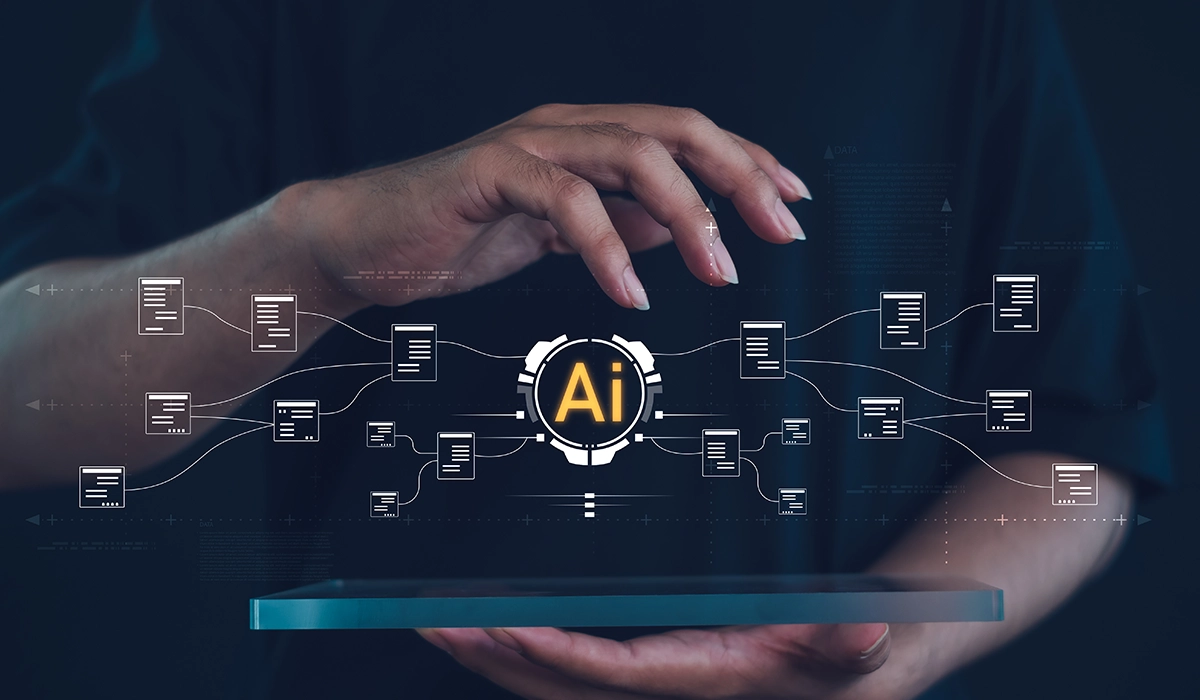
An AI-powered Security Operations Center (SOC) uses artificial intelligence to collect, interpret and act on security data across an organization’s digital environment. While a traditional SIEM platform centralizes logs, identifies suspicious patterns and generates alerts, an AI SOC takes the investigation further. It helps connect signals, establish context and support response decisions with less manual intervention.
Three components make this possible. Data ingestion pipelines aggregate telemetry from endpoints, cloud services, identity services and networks. Then, machine learning models define patterns of behavior and flag variations that may be malicious. Finally, LLMs draw conclusions from the data, correlate evidence and assist analysts by providing context to the information that has triggered an alert.
The architecture further changes how the security teams function. Instead of reacting to specific alerts and subsequently investigating these alerts one by one, AI agents can lead by asking questions on data, correlating events and executing pre-determined workflows. Microsoft’s Integrated Security Operations Center architecture follows this three-layered pattern: signals and sensors, context and actuators. Converging SIEM with threat protection, it provides shared visibility and control to humans and AI agents.
Automating Alert Triage and Signal Correlation
A security team can receive multiple alerts about what is essentially one attack. An irregular login, a suspect endpoint process and abnormal cloud activity might each be a different indicator. Analyzing each alert separately generates noise and prolongs response. AI-driven alert triage solves this issue by stitching together correlated signals from endpoints, cloud and identities into one incident.
It isn’t just about correlating events by time or source. Through machine learning, you’re able to detect anomalies by how far they stray from the norm, and through AI you can interrogate relationships between users, devices, applications and activities to differentiate a wider attack from a collection of anomalies. It can even visualize activity relating to the MITRE ATT&CK matrix, to provide security analysts with context around an attacker’s tactics and techniques.
However, correlation isn’t sufficient to weed out false positives. AI requires wider context, such as user behavior, criticality of assets and other confirmed business activity, to determine whether an anomaly is significant enough to warrant investigation. As a result, analysts devote less time investigating signals that are consistent with known low-risk activity, and more time analyzing genuine indications of compromise.
Google’s Triage and Investigation agent demonstrates the operational potential of this approach. It processed more than 5 million alerts over the preceding year. Google also reported that Gemini reduced a typical manual analysis process from 30 minutes to 60 seconds. The larger shift is clear. AI SOC automation gives security teams a way to reduce alert overload before it becomes an investigation bottleneck.
Also Read: AI SOC Platforms vs. Traditional SIEM: Key Differences, Benefits, and the Future of Security Operations in 2026
Autonomous Incident Investigation and Reasoning
After an AI system has affirmed a legitimate threat, however, the next obstacle is fully appreciating its scope. Conventional security tools require analysts to jump across networks and security tools, asks different sources of data for information, and manually joins the dots to piece together evidence. Agentic AI eliminates this task.
For instance, the investigation agent could gather together the endpoint process trees for signs of a breach, check for the associated phishing emails in your mailboxes, and analyze identity logs for irregular access. It can then cross-correlate those events with cloud and network activity to see if they’re part of one attack, reducing your analysts’ work of digging into isolated evidence with multiple tools.
The true power occurs when AI uses that evidence to build a story of attack. By piecing together, the timestamps, discovering what assets are impacted and revealing how an attacker moved through the environment, agents inform defenders where an attack originated and how broad of an impact it had. Security analysts can make better decisions on prioritization.
Unfortunately, autonomous reasoning introduces a significant question of accountability. Security teams do not want to be held accountable to anything they cannot verify. All investigations should record the evidence, data sources, reasoning steps and actions taken. This audit trail allows for compliance audits and analysts can challenge false conclusions.
Amazon Guard Duty’s AI-powered investigations exemplify this. Investigations: They examine 90 days of security information, and they link context about the result, contextual information about correlated activity, and threat indicator information. Their investigations produce findings along with confidence levels, MITRE ATT&CK mappings, evidence, and future actions for suppression, containment, or elimination of the findings. Its usefulness increases when teams are able to understand how they got those results autonomously.
The New Analyst Experience
AI joins the fight as analysts’ workload decreases as automation assumes responsibility for mundane investigation procedures, the analyst’s work will shift away from sifting through alerts and gathering forensic evidence. Tier 1 analysts can focus on overseeing the work of the automated agents, verifying the results, and searching for more sophisticated attacks that automation is unlikely to detect on its own.
But more independence must have its limits. For example, AI agents should be allowed to conduct basic procedures: automation of alerts, gathering data, monitoring specific workflows. But there should be human approval for any operations that could impact the business significantly, for example, we should not allow them to turn off a secured account, run a filter on production systems, or block valid users.
Google’s defensive design. It offers recommendations for mitigation but leaves strategic sign off to humans. The advantage of this is that security teams stay in the thick of things when it comes to decision making; the disadvantage is that the AI isn’t all that fast. Whether it’s humans working with AI or AI working with humans, dividing up responsibilities is key.
Conclusion & The Future of Security Operations
For this reason, the AI security operations center is fast becoming a business necessity for organizations managing an expanding threat landscape and an increasing volume of alerts. Unfortunately, automation on its own cannot deliver greater security. Automation requires good data sources, strong system integrations and ongoing adjustment of models to reflect adversary techniques and business context. Security teams need to test agent privileges, keep an eye on investigation quality and ensure human involvement, too. Ultimately, the winners in security will be those that blend the power of machines with human knowledge, although the future AI security operations center will be built on strong data.