The present marketing scenario is overwhelmed with data. The total is being constantly magnified with every single click, view, and transaction. Simply putting a report on what occurred yesterday or last week is not adequate anymore. Companies need tools that can look forward. Tools that can tell you what is likely to happen and also help you act fast on it.
That is where AI comes in. Predictive AI resembles an analyst. Its approach to predicting future developments is through the examination of past data, pattern recognition, and providing recommendations. Generative AI, on the other hand, is akin to a genius. It takes insights and turns them into messages, images, videos, emails. It creates at speed and scale.
It is not a matter of which one gives better ROI. The real power comes when you use both together. Intelligence guides execution. You make smarter decisions and then act faster. Enterprises using generative AI jumped to 75 percent adoption in 2024 from 55 percent in 2023. That shows it is happening fast and it matters.
Predictive AI as the Engine of Strategic Precision
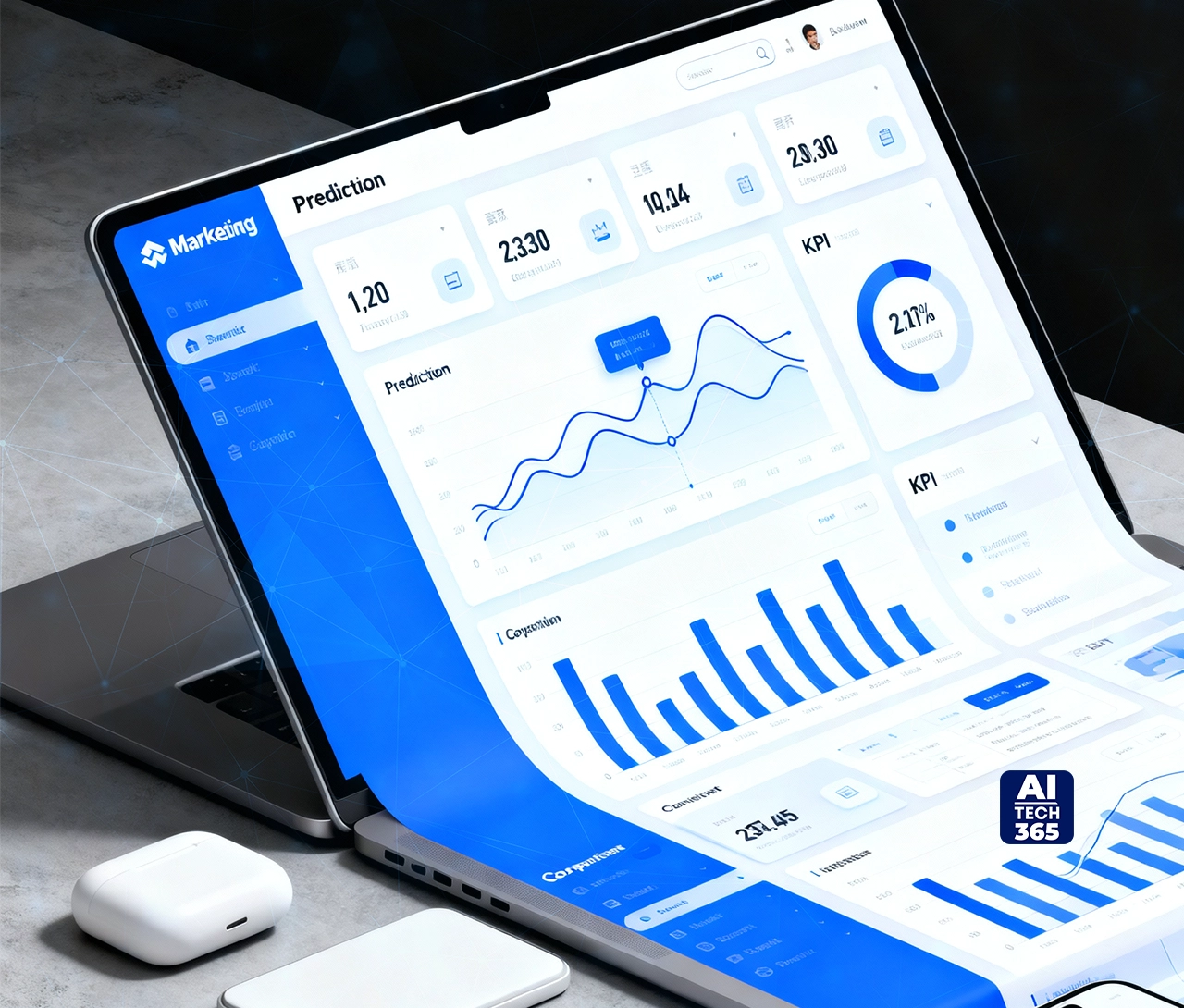
Predictive AI is basically the brain that helps marketers make sense of what is coming next. It observes past customer behavior, analyzes numerical data, identifies trends and gives possible future scenarios. It can predict who will purchase, who will churn, or which clients are deserving of attention. It is not a sorcery but just an intelligent application of data; however, it can resemble a wizardry when you witness it live.
On the ground, it changes how teams work. Lead scoring means you do not waste time chasing people who are not ready to buy. You target the ones who are the most likely to make it. By means of churn prevention, you can intercept the customers before they vanish, thus getting a chance of retaining them. Budget optimization is another thing. You put money where it matters most. Channels that are likely to give the best return get more spend, the others get less. Everything becomes more precise.
And here is where it connects with Generative AI. Microsoft Advertising said generative AI with Copilot can make ad copy, visuals, and campaign insights in seconds. That does not replace predictive models. It works with them. Predictive AI figures out what action is needed. Generative AI takes that and turns it into something you can actually use in a campaign. Faster, smarter, and without wasting time.
At the core, predictive AI is about ROI. It cuts waste, it helps keep customers, it makes sure marketing money is not thrown around blindly. When you pair it with generative AI, it is not just faster, it is better. And then the question is not Predictive AI vs Generative AI. It is how to use the brain to guide the hand and get the best results.
Generative AI as the Engine of Creative Velocity
We could say that generative AI is a partner who is always creative and never gets tired. You give it details such as your brand, your previous campaigns, your rules, and it begins to create things. Text, images, video, code, whatever you need. You give it a prompt and it comes back with options. Lots of options. Sometimes dozens, sometimes hundreds. You pick what works, tweak a little, or just run with it.
For marketers this changes everything. You can make hundreds of ad variations to see what works best. Headlines, images, copy, it all comes faster than a human team could ever manage. Personalized content is also easier. Emails, web pages, messages tailored to small audience groups. It can feel like each one was made for one person.
Rapid prototyping is another huge plus. New campaign ideas don’t sit in draft mode for weeks. You get a working version in hours. Then test, get feedback, launch. The whole process speeds up.
Adobe says 86 percent of marketing and creative leaders expect generative AI to really increase content speed and volume. That is a lot of people seeing real impact. It is not just about making more, it is about making it faster, smarter, and reaching more people.
The result is clear. Generative AI cuts down the time and cost of making content. You can experiment more, personalize more, and get better engagement. Combine it with predictive insights and you are not just making more content, you are making content that actually hits. Strategy tells you where to go. Generative AI helps you get there fast. Every message, every campaign, every asset moves quicker and lands harder.
Also Read: The Convergence of AI and Martech: What Comes After Automation
Direct Comparison of Predictive AI and Generative AI
Predictive AI and Generative AI do different jobs. They are not fighting each other. Predictive AI is about figuring out what will probably happen. It looks at past behavior, numbers, patterns. It tells you where to put your time, money, and effort. Generative AI is different. It asks how you take that insight and make it real. How you turn it into words, images, videos, or code. One decides, the other does.
You can see the difference in practice. Predictive AI needs structured data. Things like CRM records, transactions, events. Generative AI needs unstructured stuff. Brand guidelines, past content, creative notes. Predictive AI gives you scores, recommendations, budgets. Generative AI gives you text, images, ad copy, code. You measure predictive by conversion rates, customer acquisition cost, lifetime value. You measure generative by time saved, clicks, engagement.
Trust works differently too. Predictive AI is easier to explain. You can see how it came to an answer. Easier to audit. Generative AI is quicker, more imaginative, but at the same time, it is more difficult to describe. You lose a bit of transparency in return for the rapidity and the uncommonness.
The takeaway is simple. Predictive tells you where to act. Generative tells you how to act. Running campaigns, spending money, and organizing teams and now the tasks that change if you know the difference between the two. The latter impact of both coming together is where the real stories of the campaigns are told it.
Maximizing ROI with the Predictive-Generative Loop
A situation where Predictive AI and Generative AI no longer operate in isolation but rather in tandem is the point at which the actual magic takes place. Imagine it as a two-fold strike. The Predictive AI decides the likely outcome while the Generative AI decides the means to the outcome. Alone they do a lot. Together, they do more than you thought was possible.
It goes typically like this. The predictive AI examines the data and suggests what the next best course of action is. To illustrate, Customer X could be 90 percent likely to churn within a month. Predictive AI marks that and recommends, make them a retention offer. That is the first step. Then Generative AI takes that insight as a prompt. It can make five different email subject lines for that customer segment, each with a 15 percent discount offer and a supportive tone. You get options. You pick what works or test them all.
Then comes optimization. Once the emails go out, the performance data feeds back into the predictive model. It learns. It gets smarter. Next time it can predict even better. The loop continues. Predictive decides. Generative creates. Predictive learns. Generative adapts. It keeps going.
A simple example is personalized email marketing. Predictive AI says send the email at 10 a.m., use this channel, recommend this product. Generative AI proposes the subject line, composes the body, and adjusts the tone. All three of them together create an email which is quick, individualized, and more intelligent than what an entire human team could produce together.
The partnership between Adobe and Microsoft shows how this is coming to life. With Adobe Marketing Agent and Adobe Express Agent inside Microsoft 365 Copilot, creative generation and enterprise AI infrastructure are coming together. Predictive and Generative are not just tools, they are part of a single workflow.
When marketers treat them as a loop instead of separate tools, ROI goes up. Less waste. More personalized campaigns. Faster creation. Continuous learning. The brain guides the hand, and every campaign gets smarter, faster, and more effective.
A Shift from ‘Vs.’ to ‘And’
It is generally agreed between AI wonks that Predictive AI and Generative AI are not in opposition, for Predictive AI is about creating smarter decisions. It tells you where to spend, who to target, what matters most. Generative AI is about action. It helps you create, scale, and communicate at speed. One figures out the plan, the other brings it to life.
The real marketing ROI comes when you use them together. Not one over the other, but as a team. Predictive AI becomes the brain guiding a generative hand. Each campaign gets smarter, faster, more precise.
According to Salesforce, a staggering 83 percent of sales teams relying on Artificial Intelligence (AI) have experienced a rise in revenue compared to only 66 percent of their counterparts who do not utilize AI. That shows impact.
Marketing leaders need to focus on unifying their data stack. Make Predictive and Generative work as one. That is how you stay ahead, make better decisions, and create content that actually works in the AI era.