

The durable AI advantage comes from hill climbing your agent harness, and banking every gain in the scaffolding you control.
In most enterprise AI stacks today, the model is rented.
Here is the most common scenario, you call an API or pull a frontier checkpoint, and you pay by the token or the GPU hour. Tomorrow a stronger model lands, pricing shifts, or alliances change and every competitor gets access to the same weights on the same morning.
If your advantage lives in a system prompt or a model-specific workaround, the next model release wipes your gains clean.
The model is rented. The harness is owned.
If you want your AI engineering effort to compound over time, every gain you discover has to be banked in the harness.
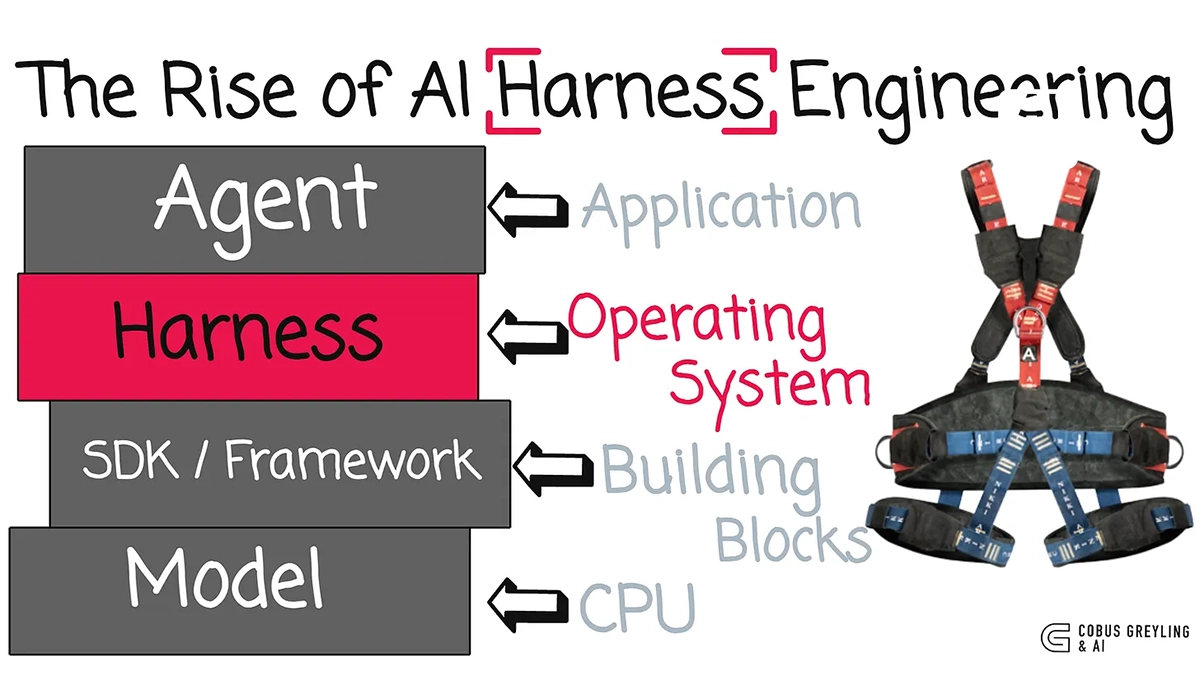
The Harness Does This
A harness is not the agent and it is not the model. But it is the software system that governs how the agent runs.
Philipp Schmid put it best with a computing analogy:
- The model is raw processing capability (the CPU).
- The context window has limited working memory (RAM).
- The harness is the operating system, managing context, initialisation sequences, tool drivers, permissions, state, and recovery.
- The agent is the application running on top.
For the past two years, teams obsessed over frameworks and system prompts. Frameworks told developers how to wire up an application. System prompts told the model how to behave in prose.
As models absorbed native planning, routing and tool calling, the bottleneck moved. And today, whether an agent works in production comes down to a simple equation:
Agent = Model + Harness
The harness manages the lifecycle around the model: tool schemas, context compaction, memory, verification middleware, human approvals, and deterministic replay. It is the layer that turns plausible model reasoning into verified work.
Also Read: AI Agents Are Rewriting the Rules of Identity Security
The Studies Show The Right Harness Moves the Score
Four recent studies put hard numbers on how much weight the harness carries.
In Harness-Bench: Measuring Harness Effects across Models in Realistic Agent Workflows, researchers tested 6 harnesses across 8 model backends and 106 sandboxed tasks (5,194 trajectories).
Holding the task and model pool constant, swapping the harness alone moved the score by 23.8 percentage points: NanoBot scored 76.2 while OpenClaw scored 52.4. Even more telling was why failed runs broke:
- 36.4% were contract or format violations (malformed JSON, a missing ledger row, an incomplete manifest).
- 24.6% were tool errors with no recovery path.
- 14.6% were claims untied to evidence.
- 11.1% were cases where the model reasoned through the answer, but never wrote the file to disk.
None of those are reasoning failures, but rather execution-alignment failures. The model knew the answer, but the harness failed to tether its reasoning to the workspace.
In LangChain’s Deep Agents study, keeping gpt-5.2-codex fixed on Terminal-Bench 2.0 and improving only the harness lifted performance by 13.7 percentage points (from 52.8% to 66.5%, jumping from Top 30 into the Top 5) through self-verification and trace-driven guardrails.
In Agentic Harness Engineering (AHE), ten rounds of observability-driven harness evolution on Terminal-Bench 2 lifted Pass@1 from 69.7% to 77.0%, beating OpenAI Codex-CLI’s hand-crafted harness (71.9%).
And in StarHarness, evolving environment-specific harnesses across enterprise SRE, ITSM, and finance benchmarks raised task completion by 20 to 35 percentage points over the default harness while cutting inference costs by 17% to 53%.
Stop Banking Your Gains in the System Prompt
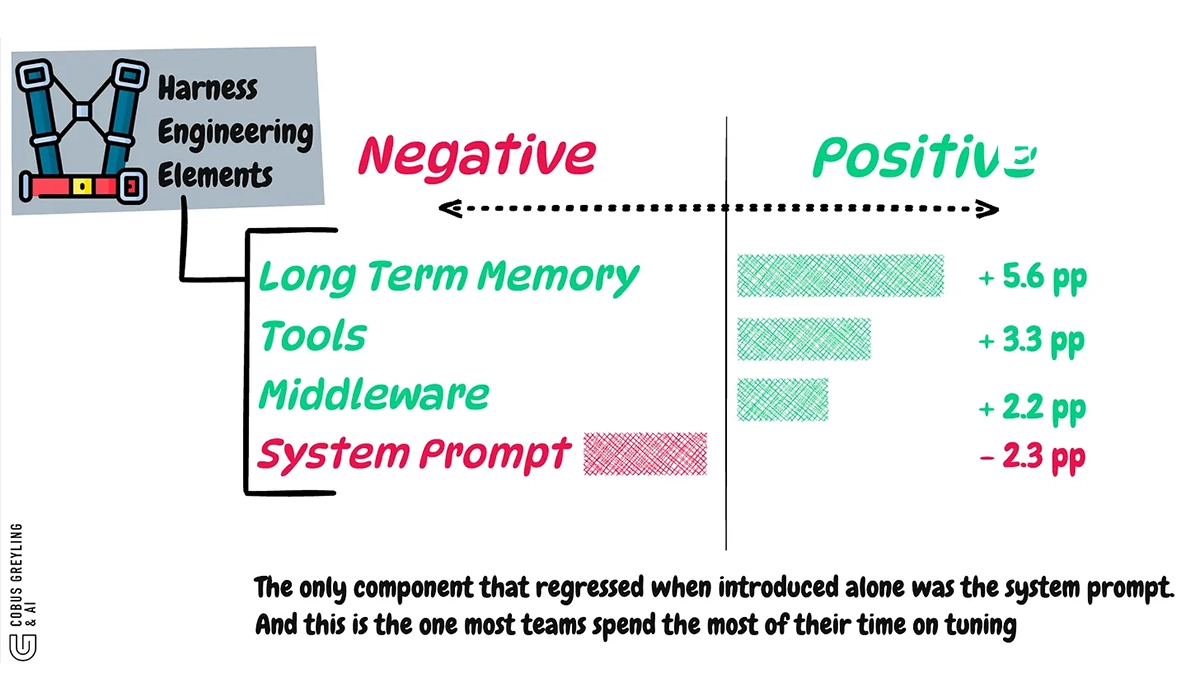
The most important finding in the Agentic Harness Engineering paper is its component ablation.
When the authors swapped each evolved component back into the seed harness on its own, the gains broke down as follows:
- Long-Term Memory: +5.6 percentage points
- Tools: +3.3 percentage points
- Middleware: +2.2 percentage points
- System Prompt: -2.3 percentage points
When the evolved system prompt was introduced alone, performance regressed.
Prose instructions in a system prompt only earn their keep when the surrounding tools, middleware, and memory exist to make them executable.
A 70-line prompt telling the model to “be careful” is brittle and tied to one model checkpoint. A middleware gate that runs an automated closure check before an agent can finish, or a tool that surfaces contract hints on error, is durable.
When the researchers froze that evolved harness and ran it across three other model families on Terminal-Bench 2, the gains transferred cleanly (+5.1 to +10.1 percentage points), and it topped SWE-bench-verified using 12% fewer tokens. Factual harness structure travels across providers. Prose prompt tweaking does not.
Hill Climbing & How You Bank Gains in the Harness
Traditional software was pre-recorded and deterministic. Agentic systems generate plans and tool calls in real time, so the same input can yield different trajectories across runs. You do not fix a probabilistic system with one-off prompt edits. You improve it through hill climbing.
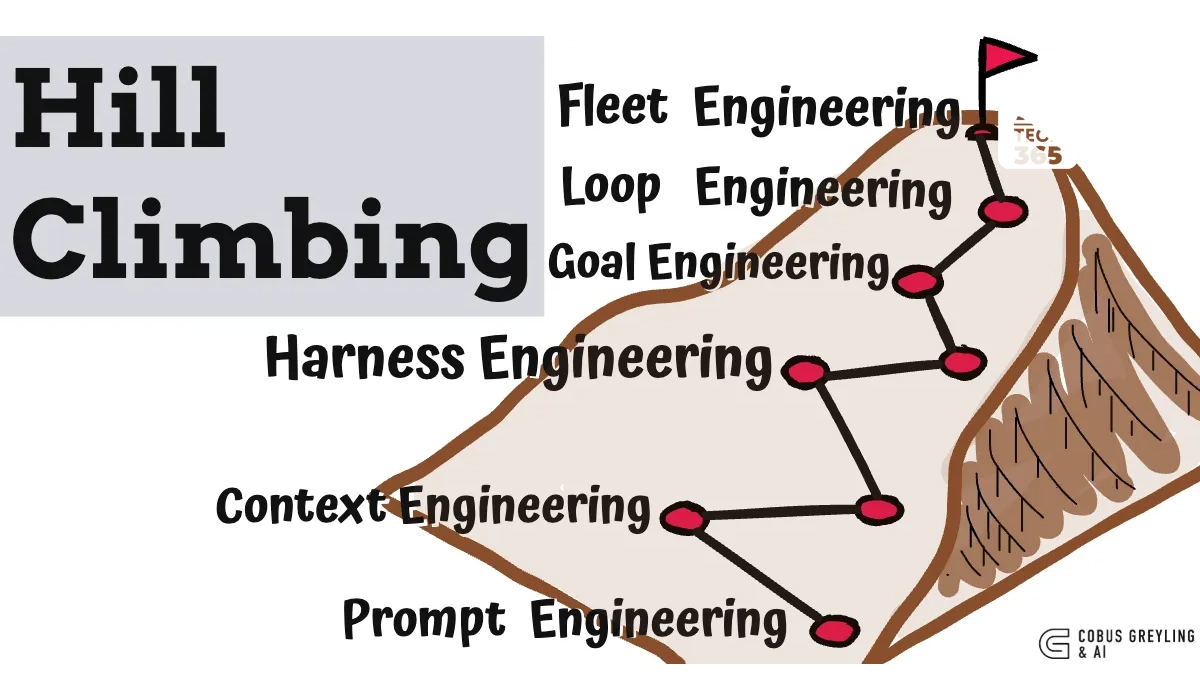
Hill climbing is evaluation-driven, iterative optimisation of the agent’s harness. You treat your configuration of tools, middleware, context compaction, memory, and verification gates as a point on a performance landscape, and run a disciplined loop:
- Instrument the traces. Scores tell you where the agent failed; execution traces tell you why. Cluster failure modes from real trajectories rather than guessing.
- Split optimization and holdout evals. As shown in LangChain’s Better-Harness recipe, hill climbing on one test set quickly overfits. Keep an optimization set to guide edits and a strict holdout set to test generalisation.
- Ship falsifiable, single-variable edits. Change one structural piece of the harness at a time. Pair every edit with a written prediction of which failures it will fix and which behaviours it might regress.
- Gate against silent regressions. In the AHE study, the evolving agent predicted what its edits would fix with 33.7% precision, but predicted what its edits would break with only 11.8% precision. Both agents and engineers have an optimism asymmetry: forward justification is cheap, defensive prediction is hard. Without automated regression gates and rollback, every tuning round leaks earlier wins.
- Bank the win in structure, not prose. When an edit passes the holdout gate, lock it into a tool schema, a middleware validator, an execution ledger, or structured memory.
Lastly
In consuming intelligence, your organisation is creating intelligence: traces, failure patterns, boundary cases, and verification rules.
If you leave those lessons inside system prompts or a vendor’s closed runtime, you are merely renting intelligence. Every time you swap models, you start over at the bottom of the hill.
When you bank those gains in a model-agnostic harness that you own, the climb compounds. Models will keep changing. Your harness keeps the books, enforces the contracts, and carries every hard-won gain forward to the next model on day one.

